
 Fa
Fa En
En
The main difference between aircraft hull and liability insurance is what the policy is designed to protect. Aircraft hull insurance generally addresses physical loss or damage to the insured aircraft, while aircraft liability insurance is designed to respond to certain legal liabilities of the aircraft owner or operator toward passengers, third parties, baggage, or other interests covered under the policy.
For example, if an aircraft is damaged during landing, the physical damage to the aircraft may fall under hull coverage. If the same event also injures a passenger or damages airport property, liability coverage may become relevant as well.
Hull and liability insurance are therefore not simply two alternatives. One aviation accident can potentially involve both types of coverage.
Aircraft Hull vs Liability Insurance at a Glance
| Comparison | Aircraft Hull Insurance | Aircraft Liability Insurance |
|---|---|---|
| Main subject of coverage | The insured aircraft | Legal liability toward others |
| Main question | How much physical damage did the aircraft suffer? | Is the insured legally liable for injury or property damage? |
| Typical example | Damage during landing or ground operations | Passenger injury or damage to third-party property |
| Financial basis | Usually linked to the insured or agreed aircraft value | Liability limits stated in the policy |
| Deductible | May apply to physical damage claims | Depends on the liability section and policy wording |
| Main financial interest | Aircraft owner or another insured financial interest | The insured facing claims from injured third parties |
| Can it replace the other? | No | No |
The exact scope of coverage, exclusions, deductibles, liability limits and policy conditions can vary substantially between insurers and individual aviation insurance contracts.
The final policy wording, endorsements and special conditions should therefore always be reviewed before assuming that a particular loss is covered.
What Does Aircraft Hull Insurance Protect?
Aircraft hull insurance, often referred to as Aircraft Hull Insurance, is primarily concerned with physical damage to the aircraft itself.

The central question in a hull claim is usually:
Has the insured aircraft suffered physical loss or damage as a result of an event covered by the policy?
Depending on the insurance arrangement, coverage may apply during ground operations, taxiing, flight or other defined operational periods.
Partial Damage to the Aircraft
Consider an aircraft whose wing is damaged after contact with ground equipment.
If the cause of the accident falls within the insured risks and no applicable exclusion prevents coverage, the repair costs may be considered under the aircraft’s hull section.
A partial loss does not necessarily mean that the financial loss is small. It generally means that the aircraft has not met the policy definition of a total loss and can still be repaired or restored.
The method of settlement depends on the policy wording, insured value, repair costs, deductibles and other contractual conditions.
Total Loss of the Aircraft
A severe accident may result in the aircraft being destroyed or damaged to a degree that meets the insurance contract’s definition of total loss.
The exact threshold should not be assumed solely from the visible condition of the aircraft.
Definitions such as total loss, constructive total loss or other settlement mechanisms may be addressed differently depending on the policy and insurance market involved.
Why “All Risks” Does Not Mean Every Risk
The term All Risks can easily be misunderstood.
It does not normally mean that every possible cause of loss is covered without limitation.
Aircraft hull policies may still contain exclusions and conditions relating to matters such as:
- geographic limits;
- permitted uses of the aircraft;
- approved pilots;
- airworthiness requirements;
- war and related risks;
- wear and tear;
- mechanical breakdown;
- intentional acts;
- policy deductibles.
An aircraft described as having all-risks hull coverage can therefore still have significant exclusions.
The policy wording is more important than the label “all risks.”
When Does Aircraft Liability Insurance Apply?
Aircraft liability insurance looks at a different exposure.
Instead of focusing on damage to the aircraft, it generally addresses circumstances in which the aircraft owner, operator or another insured party may have a legal liability toward someone else.
A liability claim therefore involves more than simply proving that an accident occurred.
Depending on the circumstances, questions may include:
- Who suffered the loss?
- What caused the accident?
- Was the insured legally responsible?
- What liability rules apply?
- Does the policy cover that type of liability?
- Is the claim within the applicable liability limit?
Third-Party Liability
Third parties may include people or property outside the aircraft that suffer injury or damage as a result of aircraft operations.
For example, an aircraft could damage:
- an airport service vehicle;
- another piece of ground equipment;
- a building;
- private property;
- a vehicle outside the aircraft.
The damaged third-party property is not part of the insured aircraft itself.
As a result, this is not simply an aircraft hull loss.
If legal liability is established and the relevant coverage exists, the loss may instead be considered under third-party liability insurance.
Passenger Liability
Passenger liability is another distinct area of aviation insurance.
If an aviation accident causes bodily injury or death to passengers, aircraft hull insurance is not designed to compensate passengers simply because the aircraft was also damaged.
Instead, passenger claims may fall within the applicable passenger liability coverage, subject to the insurance contract and the relevant legal framework.
For Iranian aviation operations, the applicable legal framework can differ according to factors such as whether the flight is domestic or international and the nature of the claim.
International aviation liability arrangements may also involve international conventions and other rules.
For this reason, legal responsibility and insurance limits should be assessed against the regulations applicable to the specific flight rather than assumed from a general insurance explanation.
Baggage and Cargo Liability
Damage to baggage or cargo provides another useful example of the distinction.
If passenger baggage or transported cargo is lost or physically damaged, the loss does not automatically become an aircraft hull claim because the property is not part of the aircraft itself.
Depending on the circumstances, the carrier’s legal liability toward baggage or cargo interests may need to be considered under a relevant liability section.
This should also be distinguished from cargo insurance purchased for the goods themselves.
Cargo insurance generally protects the insured interest in the goods, while carrier liability insurance addresses the carrier’s legal responsibility for the loss.
6 Examples That Explain Hull vs Liability Coverage
The easiest way to understand the difference is through practical loss scenarios.
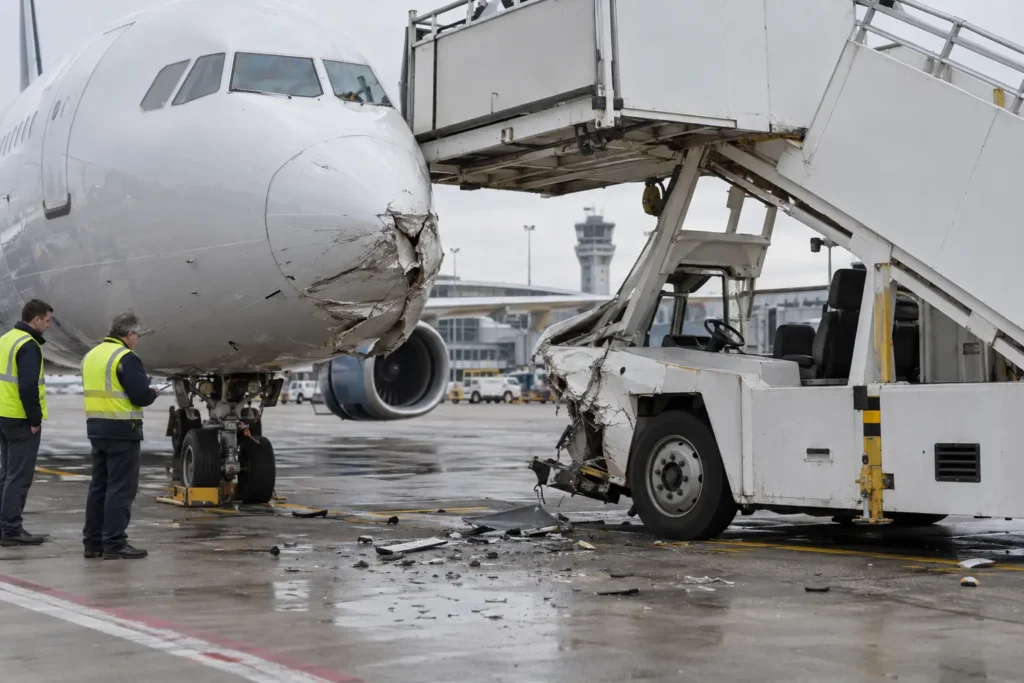
1. Aircraft Collides With Airport Equipment
Assume an aircraft strikes airport equipment while moving on the ground.
Two different losses may occur:
- damage to the aircraft → potentially a hull claim;
- damage to airport-owned equipment → potentially a liability claim.
The same accident can therefore create two separate insurance issues.
2. Passenger Is Injured During an Accident
Assume an aircraft suffers physical damage during an accident and a passenger is injured at the same time.
The insurance questions are different:
- repair of the aircraft → hull;
- passenger injury claim → passenger liability.
Having hull insurance alone does not automatically mean passenger liability is insured.
3. Aircraft Part Damages Third-Party Property
Suppose a component separates from an aircraft and damages a vehicle belonging to someone else.
The damaged vehicle is not part of the insured hull.
Any liability toward the vehicle owner would therefore normally need to be considered under the relevant third-party liability section, provided the necessary policy conditions and legal requirements are satisfied.
4. Aircraft Is Damaged During Landing
Consider a hard landing that damages the landing gear and part of the airframe without causing injury to passengers or damage to other property.
The principal insurance issue in this scenario is physical damage to the aircraft.
The claim would therefore generally be considered under hull coverage, subject to the cause of loss, policy conditions, deductible and exclusions.
5. Aircraft and Third Parties Are Damaged in the Same Accident
A more serious accident could damage:
- the aircraft;
- airport equipment;
- passenger property;
- passengers themselves.
One event could therefore generate several different claim categories.
The aircraft damage may involve hull coverage, while passenger injury and third-party property damage may involve separate liability sections.
This is why asking only “Is the aircraft insured?” is usually insufficient.
The more relevant question is:
Which interests and liabilities are insured, and under what conditions?
6. Passenger Baggage or Cargo Is Damaged
Suppose cargo or passenger baggage is damaged during transportation.
This is not damage to the hull.
Instead, the issue may involve the carrier’s liability toward the owner of the baggage or cargo.
Whether a claim is payable depends on the applicable law, contract of carriage, circumstances of the loss, insurance wording and liability limits.
Can Hull Insurance Replace Liability Insurance?
Generally, no.
Hull insurance and liability insurance address fundamentally different exposures.
Hull coverage protects an insured property interest in the aircraft.
Liability coverage protects against certain financial consequences of legal liability toward other people or their property.
A very high hull insured value does not automatically increase the amount available for passenger or third-party liability claims.
The liability section needs its own appropriate limits.
Does Liability Insurance Cover Damage to the Aircraft?
Generally, aircraft liability insurance is not intended to replace hull insurance.
If the insured aircraft itself is physically damaged, the relevant hull protection must normally be available for that physical damage exposure.
Even a high third-party liability limit does not mean the aircraft itself is insured for the same amount.
The two figures represent different risks.
Insured Hull Value vs Liability Limit
This distinction is particularly important when reviewing an aviation insurance quotation.
For hull insurance, the proposal may include an insured or agreed value for the aircraft.
This value relates to the financial interest being insured in the aircraft itself.
Liability insurance instead uses limits of liability.
A liability limit represents the maximum amount the insurer may be responsible for under a particular section, event or category of liability, subject to the full insurance contract.
An aviation insurance programme could therefore contain several different figures, including:
- aircraft hull insured value;
- third-party liability limit;
- passenger liability limit;
- baggage or cargo liability limit;
- applicable deductibles.
These figures should never be treated as interchangeable.

What Should You Compare Before Choosing Coverage?
When reviewing an aircraft insurance quotation, it is useful to evaluate the hull and liability sections separately.
For Hull Coverage
Check:
- What is the insured aircraft value?
- How is total loss defined?
- How are partial losses settled?
- Are flight and ground operations both covered?
- What deductible applies?
- Which risks are excluded?
- Are engines and relevant components included?
- Are spare parts or equipment insured separately?
For Liability Coverage
Check:
- Which categories of third parties are covered?
- Is passenger liability included?
- Is baggage liability included?
- Are cargo-related liabilities relevant to the operation?
- What is the limit for each type of liability?
- What geographic territory applies?
- Are contractual liabilities excluded?
- Are particular operations subject to additional conditions?
Aircraft model, use, operating area, pilot experience, maintenance arrangements and claims history can also affect underwriting decisions.
For this reason, two aircraft that appear similar may still receive different insurance terms.
Coverage, exclusions, deductibles and liability limits may also vary between insurers and individual policies.
Hull and Liability Cover Different Risks
The most useful way to compare aircraft hull and liability insurance is not to ask which one is “better.”
They perform different functions.
Hull insurance protects the financial interest in the aircraft itself, while liability insurance addresses specified legal liabilities toward other people or property.
An aviation operator may therefore face several different exposures from a single accident.
If the aircraft is damaged, a hull claim may arise.
If passengers are injured or third-party property is damaged, liability issues may arise separately.
For that reason, aviation insurance should be reviewed as a combination of exposures rather than as one generic policy.
For a broader overview of available aircraft insurance, including hull, liability, supplementary covers, underwriting considerations and the application process, see Bima24’s dedicated Aircraft Insurance service page.
FAGs
What is the difference between aircraft hull and liability insurance?
Hull insurance generally covers physical damage to the insured aircraft, while liability insurance addresses specified legal liabilities toward passengers, third parties or other covered interests.
Does aircraft hull insurance cover passenger injuries?
Not simply because the aircraft is insured. Passenger injury claims normally require appropriate passenger liability coverage.
Does aircraft liability insurance cover damage to the aircraft?
Generally, no. Physical damage to the insured aircraft is normally addressed through hull coverage.
What happens if an aircraft damages airport equipment?
Damage to the aircraft may involve hull insurance, while damage to airport-owned equipment may involve third-party liability if legal liability and appropriate coverage are established.
Can one accident involve both hull and liability insurance?
Yes. An accident may damage the aircraft while also causing passenger injury or third-party property damage.
Does all-risks aircraft insurance cover every possible loss?
No. All-risks hull insurance can still contain exclusions, deductibles, territorial limits and operational conditions.
What is the difference between hull value and liability limit?
Hull value relates to the insured financial interest in the aircraft. A liability limit defines the insurer’s maximum contractual responsibility for a particular liability exposure.
Are aircraft insurance terms the same with every insurer?
No. Coverage, limits, deductibles, exclusions and policy conditions can vary between insurers and individual risks.
No comment